
The Elevate Journal
- Leadership
- Nonprofit Support
- Accessibility
- Community Engagement
- Equity
- Data Collection
- Learning
- Internal Culture
- Collective Impact
- Storytelling
- Compassion
- Operations
- Project Spotlight
- Systems Change
- Facilitation
- Impact
- Evaluation
- YPAR
- Fundraising
- Focus Groups
- Data
- Reflection
- Reporting
- Surveys
- Services
- Collaboration
- Strategy
- Resources
- Stakeholders

Navigating the Long Game of Changing Systems Part 2: Testing, Learning, and Refining: Early-Middle Years
Collaborating across organizations to address root causes and change conditions at the system level is a messy, long experience. There are so many different approaches - Collective Impact, Systemness, grassroots organizing, and so on - each with their own principles, frameworks, tools, and ways of doing the work “correctly.”

Navigating the Long Game of Changing Systems Part I: The Early Years
Collaborating across organizations to address root causes and change conditions at the system level is a messy, long experience. Over the next few months, I’m going to be exploring the life cycles of collaborative efforts and breaking them down into their essential elements, based on my own research, professional experience, and Elevate’s work in this space with partners working to improve systems across a range of issues.
Does collaboration work?
Somebody asked me the other day if I really believed in collaboration. We were kvetching about the challenges of doing Collective Impact work, and at the time, I sort of laughed it off and made light of it. But it made me think…do I really think collaboration - amongst organizations within a social service landscape, to solve a specific social challenge or improve outcomes for a certain population - works? And if so, what makes it successful?
Data collection audit: What are we already collecting?
You might be surprised at what great sources of data you already have! Whether data collection is being implemented formally or informally, odds are you are paying attention to the impact of your work as well as trends in the work more broadly.
Advancing data equity
A key concept we try to infuse into our evaluation work and encourage our clients to consider is the concept of data equity, which highlights the need for fair and equitable access to and use of data in evaluation processes.
What is Organizational Learning?
For nonprofit organizations, we want to be good stewards of the resources provided to us, therefore pilots and accepted failure may be scary concepts to try. However, breaking through an organizational learning disability and creating learning networks can start small, on the individual level, and embody the best stewardship of all: adapting from what you're learning.
Storytelling: Demystifying a Dynamic Art Form and Tool
Storytelling is a dynamic art form and tool that we engage with across the service areas of our clients, transcending a singular form of use. In both its art form and tool use, the presence of storytelling invites Elevate staff into the operationalization of our mission and values as we partner with our clients in their impactful work.
Engaging Consultants to Increase Your Organization’s Impact
Running an organization is hard. In this blog, we give some helpful pointers on when it’s the best time to hire a consultant, what they can (and can’t) do for you, and so much more!
Enhancing Survey Accessibility
Several of West End Home Foundation's funded partners serve older adults who are blind or have limited vision. This challenged us and our partners at WEHF to consider ways to make our online survey more accessible to these individuals. We haven’t arrived at a perfect solution yet, but here are some strategies we’ve learned about that can make online survey data collection more approachable for individuals who are blind.
We Just Learned a Lesson – How Do We Not Forget?
While most of the thought around learning begins and ends in school, our ability and necessity to learn carries us through the rest of our lives. Because we are taught at such a young age to retain so much information, it can get tricky understanding what to keep and what to forget (I know I don’t remember a lot of the things I learned in school). As we grow and change, the necessity for a mental rolodex of dates, relationships, professional development information, songs, books, etc. increases while the proverbial room in our minds stays the same. How do we keep this information safe and readily accessible? How do we know what information is not necessary to keep on standby?
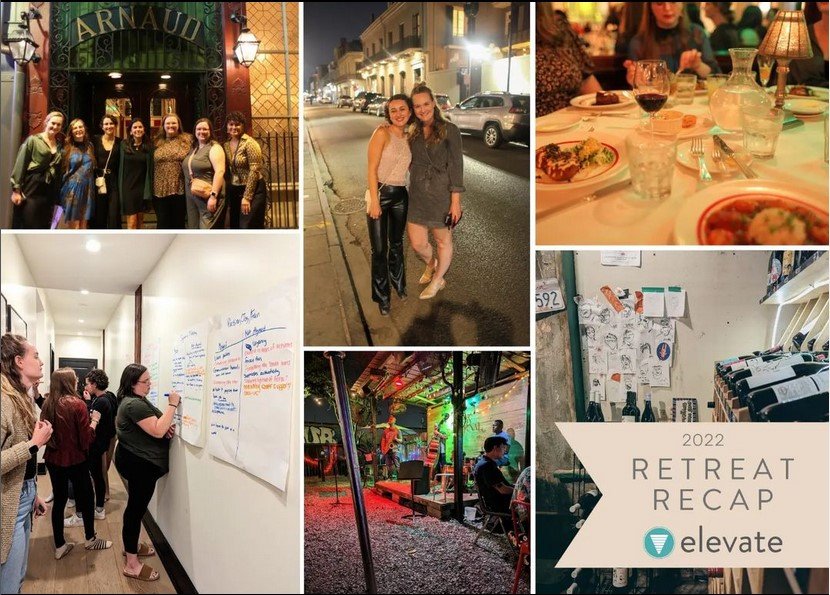
Reflections from AEA and Staff Retreat
At the beginning of November, our team attended the conference for American Evaluator’s Association (AEA) in New Orleans, and combined that trip with our annual staff retreat. AEA’s annual conference is a touchstone in the ever-evolving field of evaluation and allows professionals from a variety of sector and roles to exchange ideas and engage in dialog about the practice and role of evaluation in social change.
Elevate Pro Tips for Building Useful Surveys
Surveys are one of the most common data collection tools we encounter at Elevate, and for good reason! Surveys can be a helpful and relatively inexpensive way to gather quantitative (and sometimes qualitative) data from respondents about their attributes, perceptions, knowledge, attitudes, and behaviors. Surveys, when poorly designed, can also generate data that is not useful or usable. Here are some of our recommendations for designing quality surveys.
Reflective Practice at Elevate
At Elevate, we have a core value around learning. This often shows up in our external work with clients where we collaboratively learn with partners and actively look for ways to augment learning through the work we do and the deliverables we produce. Learning also plays a central role in the internal work we do as an Elevate team, and reflective practice is one tool we use to learn and grow together.

Facilitating Groups Utilizing Emergent Strategy Principles
At Elevate, we have the pleasure of working with many different groups working toward changing the systemic conditions that are creating and reinforcing marginalization and injustice. We do this in a number of spaces, from early childhood to homelessness to workforce development, and in every situation, we’re challenged by the complexity of the systems, the scope of the challenges, and the nuances of the relationships of the people in the room. These spaces require us to be not only skilled facilitators but also constant learners and scholars of the ways in which systems change can actually be brought about.
Survey Demographic FAQs
When designing survey tools with our clients, we often receive many questions surrounding the demographic portion of the questionnaire. Demographic questions can be tricky for a number of reasons, and there is no real consensus around best practices. In this post, we will share Elevate’s answers to some demographic FAQs that are backed by literature and our own experience in consulting.
Meeting the World with Compassion
Even at a time when the company is growing and we all feel connected to our work, we also each struggle with some version of malaise, some days more than others. At Elevate we typically view the world through the lens of systems, and this is a story about how our internal system is impacted by and can impact the external systems that we inhabit.
Spheres of Influence and the Attribution of Change
A lot of our initial conversations with clients start with some version of the following: “We really don’t know how to prove that we do x. We know that we see that change day to day, but we don’t have the data to prove that we caused that change.” The key word in this request, of course, is “caused.” Often, organizations feel pressured to demonstrate that their intervention was the sole cause of an observed change. Even when funders or stakeholders aren’t requesting that directly, it’s often assumed that “proving” that your intervention caused an observed change is still the “holy grail” of evaluation.
Identifying Stakeholders: A Toolkit
It is likely that the term “stakeholders” is one you’ve heard before. It’s used across sectors to describe someone who has an interest in and/or is affected by a business, an investment, a project, etc. Stakeholders can be individuals, communities, social groups, or organizations. At Elevate, stakeholders are an essential part of our approach to evaluation and to systems change work.
Unpacking What We Mean by “Learning Culture”
You have likely heard or read about the idea of a learning culture. If you heard about it from us, you may have seen the stars in our eyes as we talked about our earnest belief that shifting organizational cultures to center learning can transform the nonprofit landscape, leading to more engaged and fulfilled staff, stronger relationships across agencies, and ultimately, better outcomes for clients.
Evaluation Method Spotlight: Youth Participatory Action Research
At Elevate, we strongly believe that evaluation and research must go beyond the numbers to tell the stories of people and communities. As such, we believe in the value of qualitative and community-based, participatory methods and approaches, including participatory action research (PAR). Specifically, we recently had the privilege to support Nashville’s Opportunity Youth Collaborative (OYC) in conducting a youth participatory action research (YPAR) project with its Youth Leadership Team to inform the strategy of the OYC.