The Secret to a Strong Impact Story

Written by Amy Merritt Campbell
(Hint: It’s not more data.)
Here’s a paradox we run into constantly: The organizations that struggle the most to tell their impact stories are often the ones that lack the least in program data. They’ve got heaps of spreadsheets full of it. Stacks of reports drowning in it. Piles of paperwork smothered in it. And yet, when it’s time to make the case of programmatic importance to a funder, board, or new partner, their impact stories fall flat.
We consult with nonprofits and funders who engage in genuinely important work. Their impact is real: Our team sees it, their staff know it, and the people they serve feel it. Why, then, can it feel so challenging for these organizations to tell their impact stories in clear, confident, and compelling ways?
After years of sitting in evaluation planning sessions, grant writing workshops, and strategic planning retreats, we’ve realized that it’s rarely a data problem; rather, it’s the lack of a strong foundation for establishing impact stories. Enter: The Strategic Impact Map.
What, exactly, is a Strategic Impact Map?
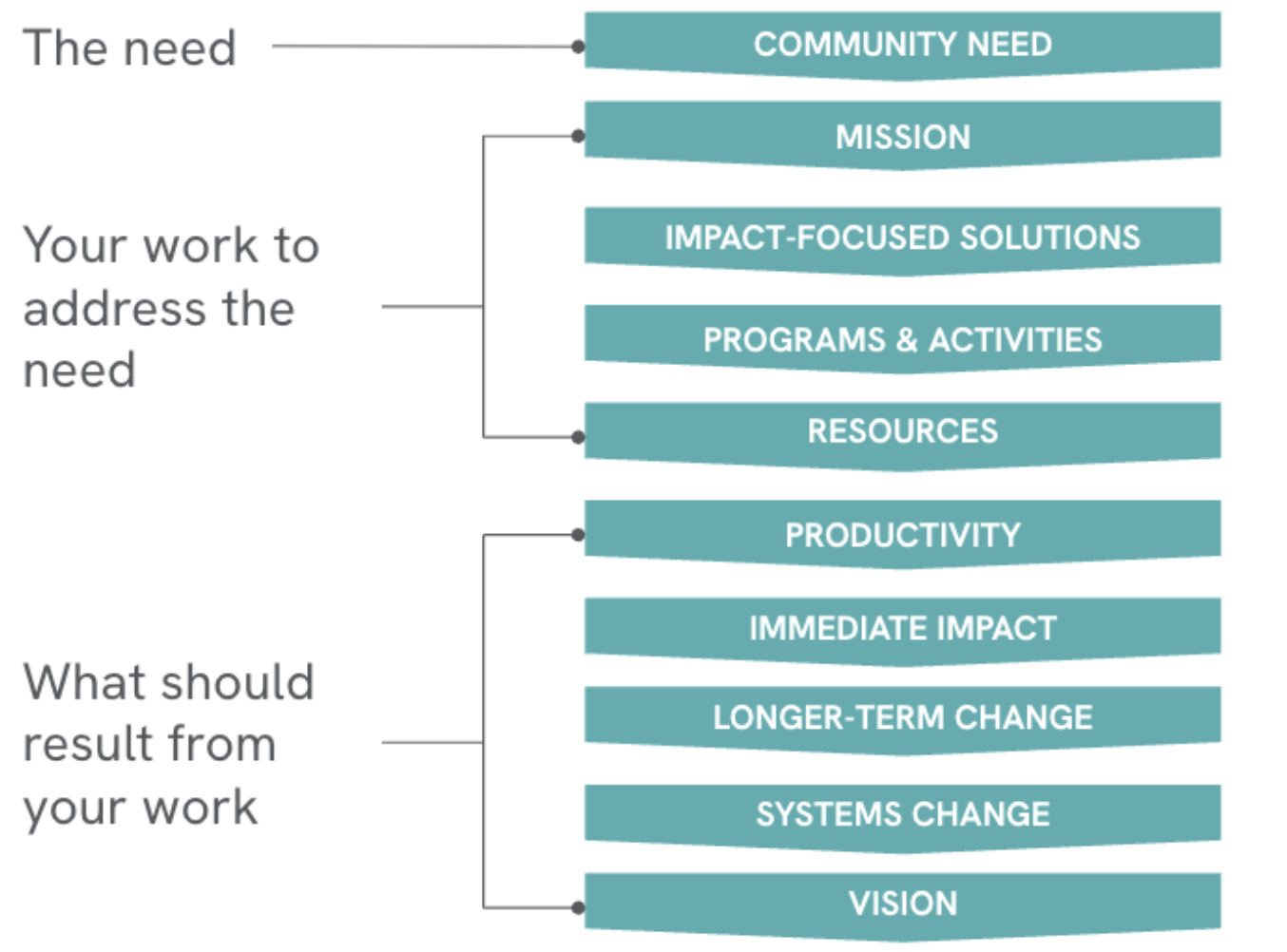
A Strategic Impact Map (we call it a SIM) is a framework that a) tells the story of how your organization accomplishes its mission, and b) makes the case for why that mission matters. It connects your day-to-day work to your long-term vision, and it provides everyone at your organization with the same language to speak and the same logic to use (the same north star, if you will).
Like a mechanical engineering team consults a new-build blueprint, a nonprofit organization’s leaders can consult a SIM. A SIM acts as the basis for an evaluation strategy, articulates key metrics, and informs data collection methods and processes.
You might also think of a SIM as a visual “impact roadmap” for your organization: It connects the community challenge you’re addressing to a) the work you do every day, b) the results people experience right away, and c) the lasting change you’re aiming to create over time.
But…isn’t that just a logic model?
Not quite. A SIM is more than a traditional logic model. Where a logic model might articulate the activities and outcomes of one specific program or service line, a SIM takes all of your organization’s activities, organizes them into “impact-focused solutions,” and makes the case for why those solutions are having an impact.
Then, the SIM grounds those solutions in research: It pairs the visual framework with a citation list linking your work to the evidence base that supports it. This means you don’t have to measure every possible downstream change. You can point to the literature, make a reasonable claim about your contribution, and focus your energy on the data you can actually collect and control.
Wait — Are you saying we don’t have to do longitudinal data collection to prove our long-term impact?
That’s exactly what we’re saying! You don’t need to collect data to prove every single impact your organization claims to make. Think about it this way: When you go to the doctor with an ear infection, you don’t expect the doctor to provide you with her own personal research proving that a specific antibiotic works; rather, you expect the doctor to base her intervention on an established body of evidence. She’s a practitioner — not a researcher — and the same is true for you as a nonprofit professional: Your citation list in your SIM does that work for you.
These two components — 1) the visual roadmap of your organization’s activities and impact, and 2) the citation list — provide you, your board, and your team with the structure and information needed to tell a coherent and concise story about your organization’s work.
What does a SIM look like in practice?
When organizations come to us struggling to tell their impact stories, their challenges usually present as one (or some) of the following scenarios:
Too much data, not enough story. The organization is collecting data for a dozen different funders with a dozen different frameworks, and none of it adds up to a coherent picture of what the organization actually does. The organization has the data needed to share individual success stories, but it lacks the framework for explaining the cumulative impact of those stories.
Pressure to prove the unprovable. The organization feels like it needs to demonstrate long-term outcomes — the ones that happen three, five, or even 10 years down the road — but lacks the resources or the runway to do so.
Everyone tells a slightly different story. The organization’s teams are all describing the same work differently, because no standardized communicational or definitional frameworks exist.
What’s missing in all three cases? A strong story architecture. To us, a strong story architecture must be:
Clear about the immediate impact and vision the organization is working toward;
Confident in “the why” and “the how” of data collection efforts; and
Compelling enough to land with any audience.
This is exactly what a SIM is designed to do.
What shifts with SIM use?
Organizations that have built a SIM tell us a few things consistently:
They finally feel clear. Organizational leaders feel confident not just about what they do, but about why it matters and how to tell that story quickly, simply, and concisely.
Their teams are aligned. Organizational departments and leadership are all working from the same framework. Grant writing gets easier. Reporting gets smoother. Board conversations get more strategic.
They can talk about their contribution to real systems change. The SIM gives organizations the architecture to say, “Here’s what we control, here’s what we’re contributing to, and here’s the research that connects the two.” By situating the organization’s work alongside a demonstrated community need, it clarifies both the organization’s value and its place in the ecosystem.
They find that data collection gets easier. A clear impact story guides data collection efforts by helping highlight which metrics are critical and which ones are just noise. Even if you have to collect different information for different funders, your SIM brings clarity to those metrics that are the most important measures of impact.
How do we build a SIM?
SIMS are created through a series of facilitated sessions (typically two to three, about two hours each) with a cross-section of stakeholders within your organization. We find that implementing the following strategies tends to optimize the process:
Include diverse perspectives. Representatives from all organizational departments need to be in the room. The SIM should reflect the full picture of your organization’s work, not just one team’s viewpoint.
Carve out real time for conversation. This shouldn’t be a rush job. Building shared language and genuine consensus takes time, and that time is part of the value.
Consider aligning it with your strategic planning process. If you’re already in a planning cycle, building your SIM in tandem means you’re building on conversations that are already live. Your SIM informs your strategic goals, and your strategic plan is better aligned to help you live out your mission.
Revisit it regularly. Your SIM isn’t a “set-it-and-forget-it” document. As your programs evolve, your indicators should, too.
Ready to build your SIM?
A SIM isn’t a strategic plan, an evaluation report, or a grant template (though it does make all three easier to produce); rather it’s a framework that gives your whole organization the same blueprint for telling its impact story.
If your organization is heading into a new strategic planning process, a new funding cycle, or you’ve just felt that nagging sense that your impact story isn’t hitting the mark, then it might be time to create that useful SIM blueprint.